CLICK HERE FOR THOUSANDS OF FREE BLOGGER TEMPLATES »
Showing posts with label Race Horse. Show all posts

Saturday, July 17, 2010

Stable Spotlight: Darley/Jonabell Farm

Darley/Jonabell Farm, Lexington, Kentucky

Located on 780 acres in the beautiful rolling landscape of southwest Lexington, Kentucky, Jonabell Farm is an equine development for Darley Stud. This farm is home to more than 170 thoroughbreds and accommodates all aspects of equine life. Jonabell’s history dates back to 1946 when it was started by noted horse breeder John A. Bell III, who it was originally named for. During his tenure, the farm was home to several important stallions, most notably 1978 Triple Crown winner Affirmed. In 2001, it was bought by Darley (owned by by Sheikh Mohammed bin Rashid Al Maktoum, ruler of Dubai and vice-president of the United Arab Emirates) as their breeding operation, though it retains the Jonabell name. He and his junior wife, Her Royal Highness Princess Haya bint Al Hussein, daughter of King Hussein of Jordan, are both very involved in horses. She rode for the Jordanian show jumping team in the 2000 Olympics. He oversees a global breeding operation in six countries. Jonabell serves as the sheik’s stallion operation; among the 15 stallions standing at stud on the farm are the 2007 Kentucky Derby winner Street Sense and his rival Hard Spun, Bernardini, and top American stallions Medaglia d'Oro (Rachel Alexandra's daddy) and Street Cry (Zenyatta's sire). Darley has the distinction of being the only farm with the sires of four Kentucky Derby winners standing at stud at the same time. A stud fee, at Darley, ranges from $7,500 to $150,000.

Darley is spotless. Every inch of the breeding barn is pressure-cleaned each morning before the stallions are brought in to take care of business.

main stallion barn at Darley


Not only has Sheik Mohammed been the leading buyer at the September yearlings sales over the past eight years, spending $245.6 million, but he has also built a commercial breeding and racing business here that is poised to rule the sport the way the legendary Calumet Farm did in the 1940s and 1950s. In 1998 he took possession of Raceland, near Paris. He purchased that 650-acre farm from the Hancock family's Claiborne Farm. His brother, Sheikh Hamdan, owns Shadwell Farm, including its Nashwan Stud division, which is very close to Jonabell. A third brother, Sheikh Maktoum, owns Gainsborough Farm in nearby Woodford County.


The classic white wooden fences crisscrossing the undulating bluegrass are a thing of the past at Darley. The farm uses new-age plastic/vinyl/rubber fencing to protect the horses.
Affirmed, the 1978 Triple Crown winner and the last thoroughbred to accomplish the feat, was buried whole standing up, and facing the viewer, directly under his statue at Darley along with the familiar flamingo pink and black silks of owner/breeder Lou and Patrice Wolfson's Harbor View Farm. Thirty years ago, he gave his sport not just its last Triple Crown, but an amazing rivalry with a horse named Alydar. Even though Affirmed died before the sheik acquired the farm, he wanted to make sure the legendary stallion had a fitting memorial. Affirmed lived in reverence until January 2001 and the age of 26.


2010 Fee: $150,000 STANDS AND NURSES, Sire of Undefeated Zenyatta, Champion Street Sense and Multiple Record Breaker Street Boss

Wednesday, January 13, 2010

Lucas: GRATITUDE FOR AN AMAZING HORSE

How about some uplifting news on a slow Wednesday?


By SUE MANNING
THE ASSOCIATED PRESS

WALNUT — Lukas was all bite, buck and bitterness before Karen Murdock adopted him six years ago and made him an Internet star.

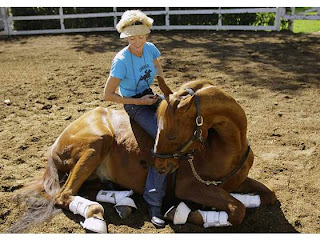
Murdock introduced the 16-year-old Thoroughbred to carrots and kindness, helped him forget years of abuse and taught him tricks: He can smile, yawn, kiss, nod, identify shapes, numbers and letters, fetch, wave, salute, pose and stretch — and he does some of it with his front feet on a pedestal.

The 1,200-pound gelding has a Web site, is a star on Facebook, YouTube and Twitter and has been on TV. He and Murdock get up to 200 e-mails a day.

The story of Lukas has to be patched together in places. California bred, he ran in three races as a 2-year-old under the name Just Ask Mike, but "he was a back of the packer. His heart wasn't in it," Murdock said.

Between 1995 and 2001, he probably changed hands a couple of times. When a Southern California horse trainer saw Lukas in a yard, "He was malnourished, neglected and emaciated. His tail was a solid mat of mud and debris," Murdock said.

The trainer bought him, then sold him to Murdock for $2,000 in 2003.


"I had to let his mane grow long so I would have something to hold on to when he did this wild, spinning, bucking kind of thing," Murdock said. "He would spook in his own stall. He had a whole lot of fears and phobias. You couldn't touch his ears. There were no scars, just mental worries, apathy and mistrust."

It took her a year to untrain him.

"I use trick training as a tool to bridge what is not right into what I want," said Murdock, who has been working with horses since she was a teenager. "Lukas flourished. He cannot get enough of learning. He's like a sponge."

Now he is a liberty horse (performs without tack) who can do the Spanish Walk (front and back), passage (a hesitating trot) and jambet (a three-legged pivot). He also does the bow, obeisance (curtsey with his face between his legs) and rear (goes up on his hind legs).

The Human-Equine Alliances for Learning in Chehalis, Wash., which offers programs in psychotherapy and personal growth, asked to study Lukas. Lukas and Murdock show the "connectedness" that enables horses to be so therapeutic for humans, HEAL spokesman David Young said.

But it's unlikely the study will clear up history's mystery question about smart horses.

There is no scientific data to support the notion that horses have the cognitive ability to count, spell or read, Dr. Emily Weiss, the ASPCA's equine behavior expert, said in a telephone interview from Benton, Kan.

She looked at Lukas' Web site.

"What is more amazing and more astonishing (than intelligence) is that this horse is so cued in, has such an incredible bond with its owner, such a great understanding of his human. The way they interact is pretty profound," she said.

There have been parallels drawn between Lukas and Beautiful Jim Key, an Arabian horse who may have performed before as many as 10 million people from 1897 to 1906 because of what seemed to be his ability to read, write, spell, count, tell time, sort mail and use a telephone and cash register.

Weiss also tells the story of Clever Hans, a horse in Germany in the 1890s owned by William von Osten. He was said to be able to spell or solve any math problem by simply stomping his hoof with the answer.

"He was all over the news. It was astounding," she said.

Clever Hans was challenged at every turn — there was even a Hans Commission. Professor Carl Stumpf and a man named Oskar Pfungst tested Clever Hans and determined the horse was getting cues so subtle that even the questioners didn't realize they were giving them.

"It wasn't that the horse knew math, he was just very cued into human behavior," Weiss said. "The horses are reading the behavior of their person instead of understanding the language of science."

Murdock doesn't care why Lukas does his tricks or the reasons for their bond.

When she arrives each day at the Brookside Equestrian Center in Walnut, about 25 miles west of Los Angeles, Lukas greets her with big, sloppy kisses. The Montana native and trained psychiatric nurse doesn't own a whip. Lukas performs for love and carrots — he eats 5 pounds a day.

Lukas recently became the spokeshorse for the Southern California chapter of the Communication Alliance to Network Thoroughbred Ex-Racehorses (CANTER), a national volunteer group that helps racehorses find second callings. Every year, the careers of about 37,000 U.S. Thoroughbreds come to an end. About 2,000 of those ex-racehorses come from California and too many end up abandoned, abused or sent to slaughter.

Bonnie Adams, the Southern California chapter's director, believes Lukas is the perfect spokeshorse because of his background and turnaround.

"He's a very kind, quiet horse. But his eyes never leave Karen. You can see the love in his eyes," she said. "It shows people that horses really do have deep feelings. They are not throwaway animals."

Visit http://www.playingwithlukas.com/ to see photos and videos of Lukas.


"In California every year there's about 2,000 that leave the tracks that need homes," said Bonnie Adams, director of the southern California chapter of CANTER. "It's an unending supply of racehorses that retire from age 2 to 6. They're young, healthy vibrant horses that really love to learn and love having a job."


Friday, January 1, 2010

ZENYATTA


Zenyatta, the undefeated champion 17.2 hand mare who finished her career with a perfect 14-for-14 record by beating males with her dramatic late charge in the Breeders’ Cup Classic, was saluted at Santa Anita on opening day, Dec. 26th. I was lucky enough to be there that day.

Everyone knew Zenyatta was scheduled to appear after the sixth race, but few knew exactly when or from which direction she would come. As a prelude, the crowd was treated to one more viewing of this year’s Breeders’ Cup Classic on the huge infield screen.

This video has become a familiar work. As Zenyatta was seen passing the 11th and final horse, with nothing but open ground in front of her, many in Saturday’s gathering accompanied Trevor Denman on the last five syllables of his now-famous call:

“Un-be-liev-a-ble!”

When the replay was over, and the crowd had quieted down, Denman instructed everyone to look to the quarter-pole. And suddenly there she was, just a dark shape at first, difficult to pick out on this overcast day — at least from the rail in deep stretch — until she’d come off the turn.


The cheering rolled up the grandstand as Zenyatta, ridden by long-time exercise rider Steve Willard, glided through the stretch, looking as fit and elegant as ever. Somewhere around this time, the sun came out.

Mike Smith then took a turn in the saddle, parading Zenyatta back and forth in front of the crowd before entering the winner’s circle. While another brief ceremony was taking place, Zenyatta struck the expert winning pose she’d perfected during 14 consecutive victories. Then, with Willard back aboard, she passed before the grandstand one last time and was gone.

Girl Power at the Breeders’ Cup: Zenyatta’s Brilliant Comeback Wows the Nation

What an incredible, brilliant race. Zenyatta…girl power indeed.

Zenyatta recorded a brilliant win in the $5.45 million Breeders’ Cup Classic at Santa Anita, California on Nov. 7. I hope you saw it, either in person or on TV.

Zenyatta became the first female to take the coveted 1¼ mile (2000 metres) race, notching her 14th straight win in the process.

Settled in her customary position at the rear of the field under Mike Smith, Zenyatta was some 10 lengths off the lead in the back stretch and looked to have work to do entering the final turn. Having to come around horses, the striking dark bay mare came with a scintillating run down the home straight, flying home to win by a length from Gio Ponti, with Twice Over third.

Now five years old, Zenyatta’s 14 consecutive wins bettered the record of another great distaffer, Personal Ensign. Having capped a perfect season in 2008 with victory in the grade 1 Breeders’ Cup Ladies’ Classic at the same course, this season she has added four further wins at the highest level.

Speaking after the race, her trainer said: ”Tears are coming to my eyes. I can’t believe it – what a great, great filly. She’s special. She came out on the wrong lead and took some time to get going but she’s all heart.

”There was a little bit of chaos at the start and she got upset and I was a little concerned. She was slow early and I didn’t necessarily want to be that far back. She came round and I still didn’t hit all the gears. She’s the horse of the decade. She’ll go down as one of the all-time greats.”

I couldn’t agree more. Horse of the Year? Some may argue against her, but not me.

Not if you saw that great race.

Zenyatta rules.

Monday, February 16, 2009

President's Weekend

To start the long weekend off, we met some friends out for some fun...We took the dogs up to Angeles Crest to play in the snow...And I got to spend some time with the horses.

The first foal of the year was born at the farm where Mazzy lives. The baby is a beautiful filly by Orientate and out of Floatlikeabutterfly. She was born on Monday, February 9. I love the fuzzy whiskers and soft curly manes babies have! She is so sweet and curious.

Wednesday, June 18, 2008

Let your heart run wild with Secretariat...

Tuesday, February 19, 2008

Somis filly invokes the spirit of Seabiscuit


Lovely article by Rachel McGrath

Odds were against a Somis filly winning, but after three years of racing, she's worth $600,000

Amid the avocado and lemon groves in the hills west of Moorpark, horse ranches and stables are dotted along the canyon roads, hidden from the casual passer-by.
On one of these parcels of land, Carl Grether balances agriculture with his passion for racehorses. After years running his father's 75 acres of citrus and avocado trees, which he now owns, he bought an adjoining 25-acre horse ranch in 2005 and has spent the past three years building up a horse training facility with the aim of racing and breeding thoroughbreds.
Little did he know in 2005 that the filly he was about to buy for $37,000 would be worth $600,000 three years later and that his father's ranch would become No. 20 in the nation in earnings.
Nearby, there used to be a horse farm owned by Lin Howard, the son of Charles Howard, who was the owner of the legendary racehorse Seabiscuit.
Lin Howard followed in his father's footsteps, and in partnership with horse racing fan Bing Crosby established Binglin Stable, as it was known, in the late 1930s.
In 1950, after the death of Charles Howard and the sale of his northern California ranch, his life-size bronze statue of Seabiscuit was brought to his son's ranch.
"The word is that Seabiscuit was buried here," said Camarillo resident Grether, 51, gesturing to the land around him that used to be Binglin Stable.
"That's what all the old farmers say."
That rumor flies in the face of the official story that Seabiscuit was buried under an oak tree at the Howard ranch in Mendocino County.
But whether or not Seabiscuit lies close by under the avocado and lemon trees, maybe his spirit is lingering a little over Carl's ranch, Tom Grether Farms, still named for his father, who owned it before him.
Filly's first race June 30
In September 2005, Grether and his racing trainer, Gary Sherlock, bought a yearling thoroughbred at the annual horse sales at Keeneland, Ky.
They paid $37,000 for the dark bay filly that stands just 15.3 hands. Grether named her Intangaroo.
After breaking her in and preparing her for a career on the racetrack, Grether entered the horse in her first race June 30 at Hollywood Park in an allowance maiden, which is a race for fillies and mares that have never won.
On June 28, just two days before the race, Carl visited with his father, Tom, who had instilled a love of horses in Carl from the moment he took him to his first horse race at the age of 13.
Carl told his dad that he thought Intangaroo, at odds of 14-1, had "a pretty good shot" at being placed in the race, which had a $60,000 purse.
"He gave me four hundred bucks and told me to put it all on to win," Carl said.
The next day, Tom Grether, who was 80 and had Parkinson's disease, had a major stroke and was hospitalized. He was on a ventilator with no chance of recovery.
"All the family got together at my brother's house, and we watched the race there. We were waiting for my sister" who had to return home from Europe. "After that, when my sister arrived, we all went to the hospital to say goodbye, because we had to take him off life support."
Carl sat with his dad through the night until he died at sunrise.
"It was pretty emotional," he said, "but dad's last bet was a winner at 14-1."
Tom Grether was buried with the winning ticket in his pocket.
Suffered a leg injury
Shortly after Intangaroo's first win, jubilation turned to sorrow once again when the horse took a misstep on the track and suffered a leg injury.
She was brought back to Grether's Somis ranch, where over the course of several months, she was nursed back to health by his staff, including his ranch manager and trainer Terri Hickey and her husband, Bill.
The Hickeys managed actor Robert Wagner's horse ranch in Hidden Valley for many years, and Terri Hickey said she knew instinctively that Intangaroo was "a natural athlete."
"It's something that's born into them, and through maintenance and proper training, you enhance that, and you just try to encourage that natural instinct," Terri Hickey said.
By the end of 2007, Intangaroo was sound again, and she returned to racing trainer Gary Sherlock's stables at Hollywood Park.
"Gary was a trainer first and then he got sick and he became an insurance underwriter for the racetrack and horse mortality insurance," said Grether. "We met in Kentucky in 2005, and he told me he was going to go out on his own, so we decided we'd buy a couple of horses and train them out here and see how it worked out."
'An upset victory'
By the start of 2008, Intangaroo was back in form. On Jan. 11, ridden by 24-year-old jockey Alonso Quinonez — who had only recently completed his apprenticeship — she won a race at Santa Anita Park.
As a result, Sherlock and Grether decided to take a huge gamble and enter her in the Grade 1 Santa Monica Handicap, once again with Quinonez in the saddle, on Feb. 2 at Santa Anita.
Grether acknowledges that he hoped his horse might place third, giving him a small share of the race's $250,000 purse.
Against all odds, however, Intangaroo won the Santa Monica Handicap in what ESPN racing correspondent Steve Andersen describes in his online report as "an upset victory."
At 26-1, Intangaroo was the longest shot in a field of five in the seven furlong Grade 1 Santa Monica Handicap. She came from behind in the last quarter of a mile to win by a nose.
"We were sitting in a box right on the wire, and then suddenly I see her coming up the rail, and then when they crossed the wire, I knew she'd won," Grether said. "It's just a very exhilarating feeling.
"In the winner's circle there were a lot of tears. My wife was crying. A whole bunch of people were crying," he said. "I was more in stunned shock."
'She's got a great mind'
Trainer Sherlock said Intangaroo's win seemed almost effortless after her battle with injury.
"She's come out of the race perfectly," he said by phone from his stables at Hollywood Park. "She has a long stride even though she's not very big, and she's got a great mind."
"Nothing rattles her, and she's going to improve even more."
It's highly unusual for a horse to go from a maiden race to a Grade 1 race and win it, Grether said.
As a result of her win, the $37,000 4-year-old filly is now worth at least $600,000, a value that she won't lose even if she never wins again because she's proved her worth as a brood mare.
Owner's ultimate dream
In an interesting twist, Intangaroo was sired by Orientate, who, according to the Web site The Virtual Form Guide, "was rated the World's Best Sprinter in 2002." In the 2002 Breeders' Cup, Orientate beat Crafty C.T., owned by Carl's father, Tom Grether.
"Right now, Tom Grether Farms is No. 20 in the nation in earnings so far this year, and Intangaroo is No. 6 for earnings of all the racehorses in the country," said Grether, who currently has 60 horses at his Somis ranch as well as several others stabled at the Hollywood Park racetrack and at Turf Paradise in Phoenix.
Grether and Sherlock haven't yet decided whether they'll run Intangaroo in Las Flores Handicap at Santa Anita on April 6, but if she does run and she wins, they plan to run her in the Humana Distaff Handicap, a seven furlong race held at Churchill Downs on Kentucky Derby day.
The ultimate dream for Carl Grether, though. is to enter Intangaroo in this October's Breeders' Cup sprint at Santa Anita and for her to cruise to victory, six years to the day after her sire beat his father's horse.
"Carl picked her, and from the moment she came here she's always been special," said Terri Hickey. "She's brought Carl a lot of good luck."
Maybe the spirit of "a little horse that could" is somehow still alive in Somis.

Floating Social Media